How It Works
- Parametric Triggers: Payouts are based on pre-defined weather thresholds (e.g. rainfall or wind speed), not on individual damage assessments. If the trigger is met, the payout is automatic.
- Fast Payouts: Beneficiaries receive funds within days, no claims process, no paperwork. Payments made within 14 days of the event
- Affordable Premiums: Designed for accessibility, often bundled with savings or credit union services.
- Inclusive Coverage: Targets low income and informal workers, women, rural communities and peri-urban communities who are often excluded from traditional insurance.
- Distributed via Aggregators: Credit unions, cooperatives, NGOs, and community groups help enroll and educate beneficiaries.
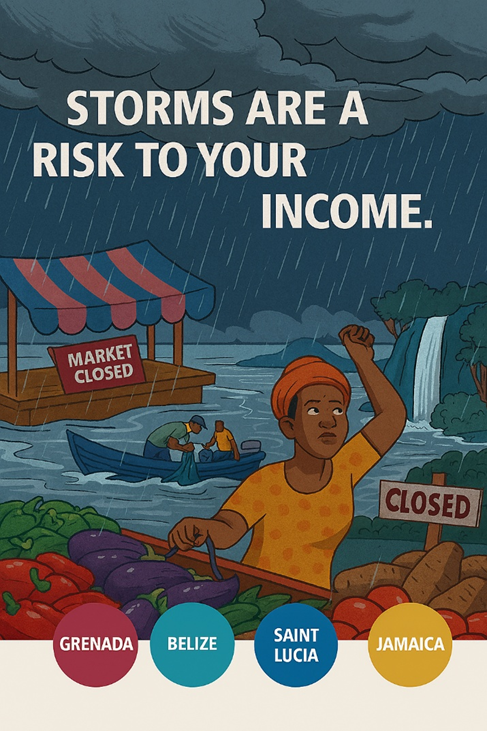
The LPP is a parametric microinsurance product. In simple terms, let us explain how this works for say rainfall:
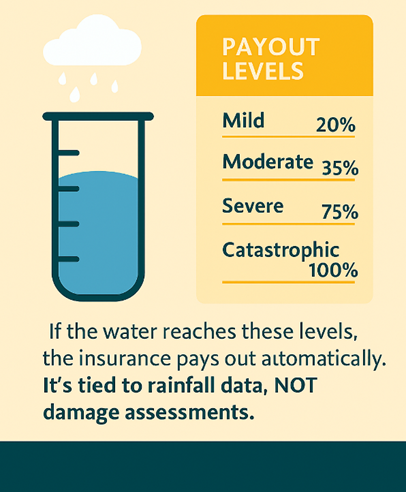
- Insurance payouts are triggered by weather data.
- CCRIF models determine hazard intensity and payout eligibility.
- Four trigger levels: Mild, Moderate, Severe, Catastrophic.
- Think of insurance like a rainfall gauge - once the water crosses a line, the payout flows.
- It is not about the damage you see; it is about the rainfall measured.
- Speed and fairness come from using objective data, not paperwork.
Let’s explain some more.
Say there is a storm or hurricane or heavy rainfall, satellites measure the local rainfall and CCRIF’s SPHERA model estimates the wind speeds, using storm track data from the US National Hurricane Center (NHC) at the National Oceanic and Atmospheric Administration (NOAA).
We use the data for each country’s location, parish, county – or part of the island depending on your country – and compare this information to the trigger levels related to your location.
An LPP policy payout can be triggered by wind or rainfall or both.
LPP payouts are triggered based on the values for wind speed or rainfall level.
The “trigger values” are based on actual weather events that have occurred in the past and are different for policyholders depending on where they live.
The payout is done per peril.
For each peril, the payout amount is calculated as a percentage of the amount of coverage for that peril: the more extreme the event, the larger the payout.
For wind, a payout is triggered if the maximum speed of winds in a storm equals or exceeds the trigger wind speed for your location. The wind speed triggers are shown in the table below – measured in kilometers per hour (km/h).
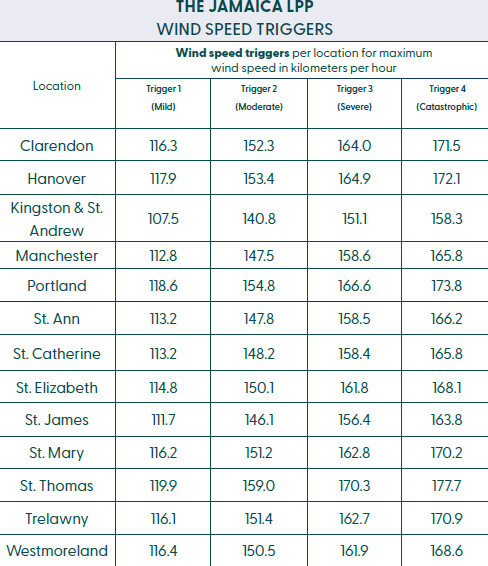
For example, following Hurricane Beryl in 2024, wind speeds in St. Elizabeth exceeded the moderate trigger level. Policyholders would have received a payout of 35% of their wind sub-limit. This demonstrates how the LPP provides immediate financial support after severe events.
For rainfall, a payout is triggered if the maximum rainfall in your location within 12 or 48 hours is significantly higher than the average for historical events in your location, thereby meeting or exceeding the rainfall triggers.
The rainfall triggers are shown in the table below:
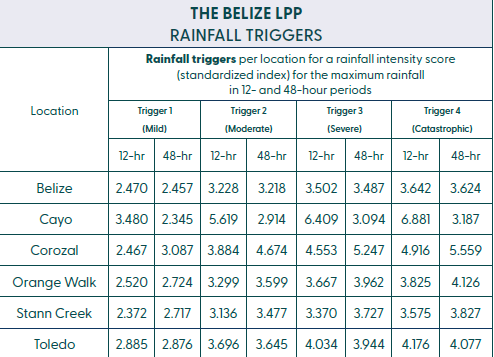
Rainfall triggers are based on how much rainfall in a 12- or 48-hour period exceeds the usual average for that location. The higher the rainfall compared to the historical average, the higher the trigger level—and the larger the payout.
For example, during Hurricane Cristobal in 2020, rainfall in Orange Walk exceeded the moderate trigger level, which would have resulted in payouts to policyholders in that location. This example helps to illustrate how the trigger values translate into real benefits.
The current version of the LPP model is underpinned by CCRIF’s state-of-the-art catastrophe risk models, customized for each country to reduce basis risk
There is no set price.
The price of the LPP is based on the amount of coverage that you wish to purchase.
Your premium, or the cost of the LPP, is calculated as a percentage of the coverage purchased.
The percentage used to calculate the price of the LPP is based on the payout rates and exposure to both perils – wind and rainfall – and other factors.
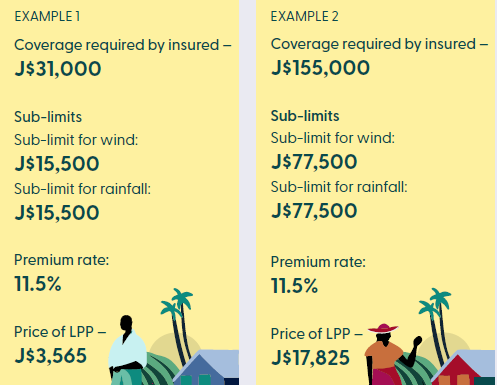
The premium is calculated as 11.5% of the policy coverage purchased.
For example: farmers in Jamaica who are interested in coverage of J$31,000 (US$200) (with sub-limits of J$15,500 (US$100) for rainfall and wind) pay a premium of J$3,565 (one time payment) regardless of their location.
Farmers who are interested in coverage of J$155,000 (US$1,000) (with sub-limits of J$77,500 (US$500) for rainfall and wind) pay a premium of J$17,825 (one-time payment).
Where taxes are applied to insurance, the LPP will be subject to the corresponding tax rate.
f your LPP policy is triggered after an event, then your insurance company or credit union will contact you by text message, email or phone to alert you that you will receive a payout.
No claims needed
You will not have to file a claim because the amount you receive is based on specific rainfall or wind speed levels, which are automatically measured.
Your payout will be quick!
Your insurance company or credit union will send you the money within 14 days after a trigger is met. The company will deposit the funds into your bank account or send it to your credit union if this is your preferred payment method.
A slow-moving storm passed over Belize, bringing strong winds of about 140 km/h and very heavy rainfall over two days (48 hours). This level of wind and rain is much higher than normal and can easily disrupt farming, fishing, tourism, and small businesses.
LPP Payout Scenarios
A Belize Scenario: Cayo and Corozal
Cayo
Wind Trigger Level 3: 138.4 km/h Triggered
48-hr Rainfall Trigger Level 3: 3.094 Triggered
Payout: Both wind and rainfall thresholds were exceeded, resulting in a Level 3 payout for both wind and rainfall. This support helps agricultural workers, vendors, and informal workers in San Ignacio and Belmopan recover quickly after the storm.
Corozal
Wind Trigger Level 1: 107.6 km/h Triggered
48-hr Rainfall Trigger Level 4: 5.559 Triggered
Payout: High wind speeds and significant rainfall met the required trigger levels, leading to a Level 1 payout for wind and a Level 4 payout for rainfall. This is especially important for corn and papaya farmers, market vendors, and small businesses that are highly affected by severe weather.
A strong Category 3 hurricane moved along Jamaica’s southern coast. It brought very powerful winds of about 165 km/h and extremely heavy rainfall, far more than what the area normally receives in two days or 48 hours.
Because the wind and rainfall were so intense, they passed the trigger levels for both St. Elizabeth and Westmoreland. This means that LPP policyholders in both parishes would automatically receive a payout, with no claims process required.
St. Elizabeth:
Both the wind and rainfall triggers were met, so policyholders would receive a payout based on the Level 3 wind trigger and Level 4 rainfall trigger.
Westmoreland:
Wind and rainfall also passed the required thresholds, resulting in a Level 3 payout for policyholders.
These payouts would help farmers, vendors, fishers, day labourers, and other vulnerable groups recover quickly after the hurricane.
St. Elizabeth
Wind Trigger Level 3: 161.8 km/h Triggered
48-hr Rainfall Severity Index Level 4: 7.074 Triggered
Payout: Both the wind and rainfall thresholds were exceeded. This means policyholders qualify for a Level 3 wind payout and a Level 4 rainfall payout. These payouts help farmers in the island’s breadbasket, as well as vendors and tourism workers, recover quickly after the hurricane.
Westmoreland
Wind Trigger Level 3: 161.9 km/h Triggered
48-hr Rainfall Severity Index Level 3: 7.926 Triggered
Payout: Wind and rainfall levels both passed the required thresholds, resulting in Level 3 payouts for both wind and rain. This support is especially important for seasonal tourism workers and small businesses in Negril’s tourism corridor.
Interested persons can sign up in just three easy steps:
- Contact your local insurance company, credit union, insurance broker, or bank.
- Share some basic information about yourself.
- Pay your premium via your preferred payment method.
Purchase 1, 2, 3, or more policies.
Remember, organizations such as co-operatives and fish sanctuaries, farmers' groups, NGOs, and even community groups can purchase group policies on behalf of their members.