
Partners
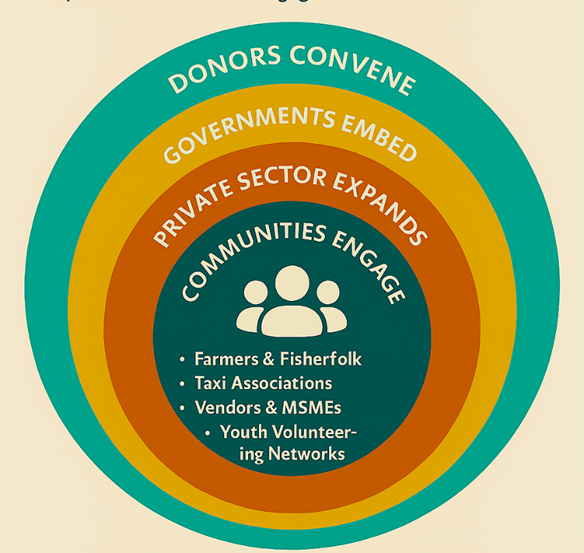
For the LPP, the key stakeholders that are involved in the design, delivery, uptake, and policy alignment include public, private, and community stakeholders.
The effective delivery and scaling of the LPP requires coordinated engagement across public and private sectors and community groups and civil society organizations.
Each stakeholder group plays a distinct role in advancing inclusive disaster risk financing, climate adaptation, and social protection.
Public sector actors ensure policy alignment and regulatory support; private sector partners drive innovation, distribution, and financial sustainability; and community stakeholders support outreach, trust-building, and equitable access.
This mapping below clarifies the ecosystem of actors essential to institutionalizing the LPP within national resilience strategies across countries.
… drive product delivery, scale, innovation, and financial sustainability.
- Insurance Companies – Underwrite and distribute LPP policies; manage claims and customer service.
- Credit Unions and Microfinance Institutions – Serve as trusted aggregators and access points for low-income clients.
- Mobile Network Operators and Fintechs – Enable SMS alerts, digital enrollment, digital marketing premium payments, and mobile-based payouts.
- Reinsurers and Risk Modelling Firms (e.g., CelsiusPro) – Support pricing, risk pooling, and model calibration.
- Agribusinesses, Tourism Operators, and MSMEs – Promote uptake among value chain actors and informal workers.
- Media Houses (including social media influencers) - Campaign amplification, and public education
… provide policy alignment, regulatory oversight, and integration with national resilience, climate adaption, social protection, and financial inclusion strategies.
- Ministries of Finance – Integrate LPP into national disaster risk financing (DRF) frameworks, risk layering strategies and fiscal resilience strategies.
- Disaster Risk Management Agencies (e.g., ODPEM, NADMA in Grenada, NEMO in Saint Lucai) – Support risk communication, early warning integration, and community outreach.
- Ministries of Agriculture, Fisheries, and Tourism – Facilitate sectoral targeting, beneficiary identification, and alignment with adaptation programmes and national adaptation strategies.
- Social Protection Ministries/Units – Enable integration of LPP into shock-responsive social protection systems.
- Insurance Regulators – Ensure compliance, consumer protection, and market development for microinsurance products. Regulators also ensure that microinsurance policies are developed and promulgated to guide the insurance sector.
- Meteorological Services – Provide localized hazard data and support public trust in parametric triggers and support model developments such as CCRIF to infuse local data into models to strengthen model accuracy.
- Local Government Authorities and Municipal Corporations – Coordinate community-level resilience planning, community mobilization and facilitate LPP integration into local DRR strategies.
… ensure community and grassroots engagement, help to build trust, and facilitate equitable access.
- Farmers’ Associations, Fishers’ Cooperatives, and Fish Sanctuaries – Mobilize members, provide feedback, and support group enrollment.
- NGOs and CBOs – Conduct outreach, build insurance literacy, and support vulnerable groups in navigating enrollment.
- Faith-Based Organizations and Women’s Groups – Extend reach to marginalized populations and promote gender equity.
- Youth Networks (e.g., youth environmental groups, etc.) – Amplify messaging among peers and the community.
- Community Leaders and Influencers – Local endorsement, support for myth-busting activities around insurance and microinsurance.
The Livelihood Protection Policy (LPP) will align strategically with national development priorities across countries such as Jamaica, Grenada, Belize, and Saint Lucia. The LPP provides a scalable, inclusive tool for disaster risk financing, climate adaptation, and social protection. Broadly this includes alignment with the following national policies and strategies:
Disaster Risk Management (DRM)
The LPP:
- Supports proactive risk reduction by enabling vulnerable groups to prepare for and recover from climate-related events faster.
- Complements national early warning systems and community-based DRM by offering financial protection tied to hazard thresholds.
- Reduces reliance on post-disaster support/aid, easing fiscal pressure on government relief budgets or forcing governments to reallocate budgets from sectors such as education and health care etc. to support relief and recovery efforts.
Disaster Risk Financing (DRF)
The LPP:
- Operationalizes shock-responsive social protection/adaptive social protection and aligns with, and complements macro-level parametric instruments.
- Enables targeted, scalable payouts to individuals and groups, improving efficiency and equity in post-disaster resource allocation.
- Strengthens fiscal resilience by integrating insurance into national DRF strategies and contingency planning.
Climate Change Adaptation
The LPP:
- Addresses climate vulnerability among informal workers and natural resource-dependent sectors (e.g. agriculture, fisheries, tourism).
- Promotes adaptive capacity by providing quick liquidity for recovery and rebuilding, reducing long-term climate impacts and building resilience.
- Aligns with national adaptation plans by embedding financial protection into resilience-building efforts.
Financial Inclusion
The LPP:
- Expands access to insurance for low-income and informal groups traditionally excluded from formal financial services.
- Improves creditworthiness and access to loans, especially when the LPP is used as collateral with credit unions and cooperatives.
- Supports inclusive growth by stabilizing incomes and enabling continued economic participation after disasters.
Social Protection
The LPP:
- Integrates with social protection systems to make them more shock-responsive and enable them to expand both horizontally and vertically.
- Targets vulnerable populations with tailored coverage, reducing the need for emergency cash transfers or asset sales.
- Supports government priorities around poverty reduction, equity, gender equality, and resilience in social safety nets.